
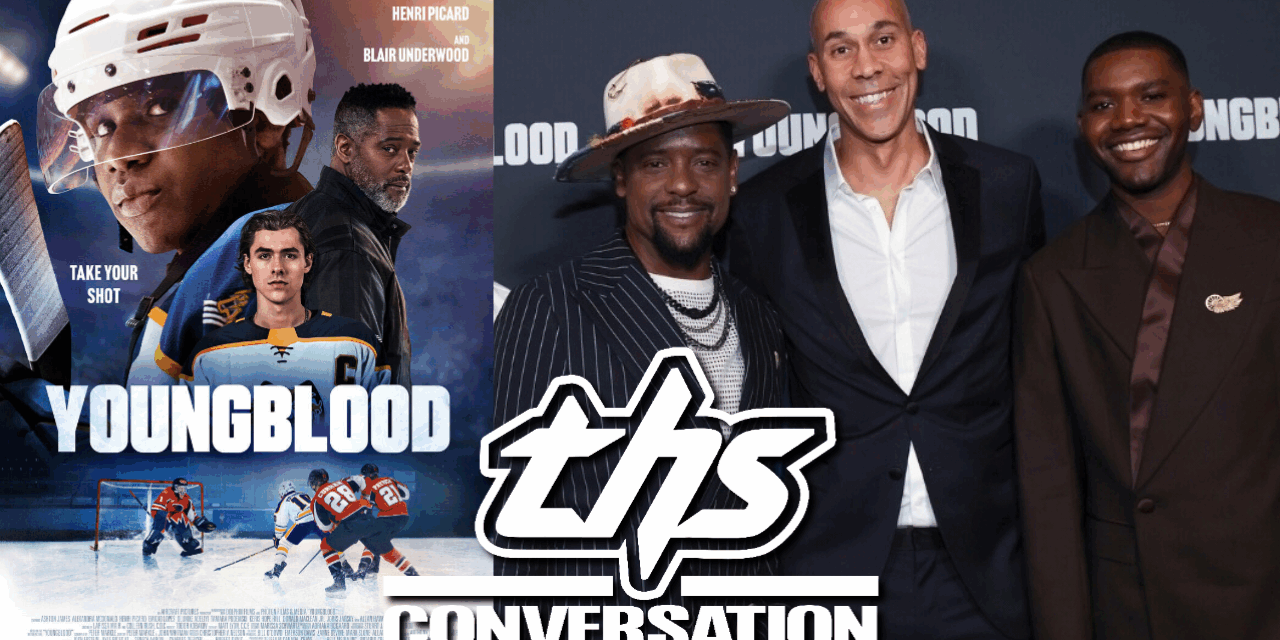
There’s a particular kind of electricity that only a great sports movie can generate. It’s not all about the glossy, slow-motion highlight reel kind. They’re the kind that remind you that sports aren’t just about winning. They’re about identity, pressure, and the quiet, complicated ways we learn to love each other.
That energy is exactly what the new take on Youngblood is chasing.
Sitting down with director Hubert Davis and stars Blair Underwood and Ashton James, they spoke about how Youngblood isn’t just a remake skating on nostalgia. It’s a reimagining with the same bones, but with sharper edges and a deeper pulse.
Love That Doesn’t Speak Softly
At the center of the film is a father-and-son relationship that feels instantly familiar. However, it’s explored through a s lightly different lens. Blair Underwood plays Dean’s father. His performance avoids the easy trap of turning toughness into cruelty. Instead, he builds a man shaped by a different era. One where you measure affection in expectation rather than tenderness.
“He loves hard,” Underwood explained. “He wants his son to succeed in ways he never could. It’s driven by aspiration and love, even if it doesn’t look soft.”
For him, and the viewer, that distinction matters. Youngblood is about pressure that comes wrapped in hope, and how that pressure lands on the next generation. Underwood, a father himself, found the role reflecting something personal. The tension between guiding your child and letting them become their own person becomes one of the film’s emotional fault lines.
Letting Characters Lead the Ice
For director Hubert Davis, stepping into narrative filmmaking after a background in documentaries meant embracing a different kind of control. Or rather, letting go of it.
“The characters have to lead the story,” he said. “You let the actors build them, and then everything else follows.”
Davis also made deliberate choices about what to leave behind from the original Youngblood. Some elements simply didn’t survive the jump to a modern audience. Outdated dynamics, heavier hazing, and tonal choices that would clash with a more inclusive, PG-13 approach were all reworked or removed.
Finding Yourself Between the Lines
For Ashton James, who plays Dean, the journey wasn’t just physical, though there was plenty of that. Learning hockey at a competitive level meant starting from shaky basics and climbing toward something believable.
“I started at very terrible,” he joked, “and now I’m slightly terrible.”
But the real work was internal. Dean’s arc revolves around a question that hits far beyond the rink. He continually asked himself this question about Dean: Are you living your life for yourself, or for the expectations placed on you?
That question lingered with James throughout filming. It pushed him to reflect on his own choices, his own motivations, and the quiet ways people lose and rediscover themselves.

![Enola Holmes 2 Drops Part 2 Of Its Trailers! [Trailer]](http://18.211.146.234/wp-content/uploads/2022/10/EN-GB_EH2_MAIN_27x40_RGB_PRE-440x264.jpg)



 That Hashtag Show
