
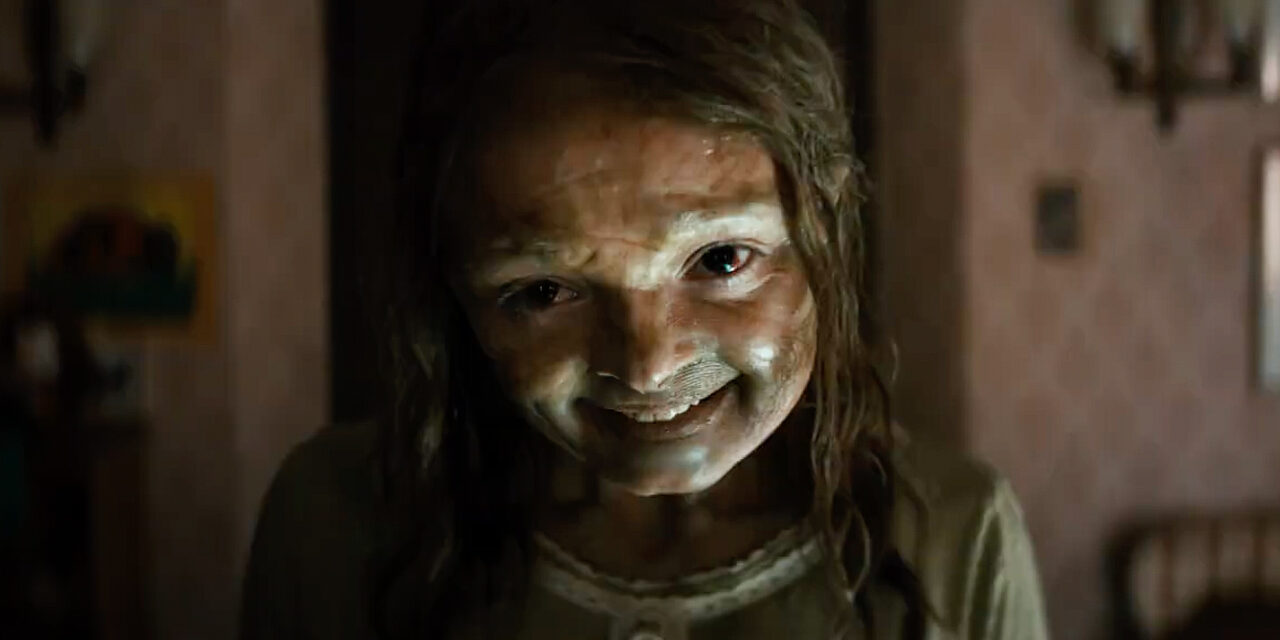
Putting your name in the title of the movie is a bold move for anyone not named Steven Spielberg or Quentin Tarantino, even if it’s just to separate it from familiar IP. I don’t know that Lee Cronin quite has the repertoire to demand such a thing, but in his latest film, he most certainly works to earn the title card. I’m by no means saying that Cronin is the next horror Spielberg, but Lee Cronin’s The Mummy is so confidently made that it’s hard to deny his growing place among the higher rankings. Fresh off his smash success of Evil Dead Rise, Cronin delivers a real nasty piece of work in his follow-up. Gruesome and gross, he carries all of his knowledge of frights and hellish visuals and unleashes those horrors on audiences from his opened sarcophagus. Lee Cronin’s The Mummy is an all-out grossfest with some gnarly violence crafted from the stuff of nightmares and is sure to test the limits of squeamishness.
But for all its visual flair and confident direction, the film suffers from some sluggish pacing and an unrefined narrative, sometimes leading Lee Cronin’s The Mummy to feel gross for gross’ sake and not always on the merits of its necessity. The lack of urgency – a product of sprawling narrative and genre blending – holds it back from being truly nightmarish, at least the kind of nightmares you can’t shake. It’s shocking and violent and definitely scary, but it’s not terrifying. It finds itself dancing around the horror tropes rather than wholly embracing them, leaving both its hard-boiled detective angle and its buried secrets horror to feel visually engaging but narratively underdeveloped. It feels more like Evil Dead Mummy than a singular Lee Cronin’s The Mummy, and makes its inspirations a little too clear sometimes.
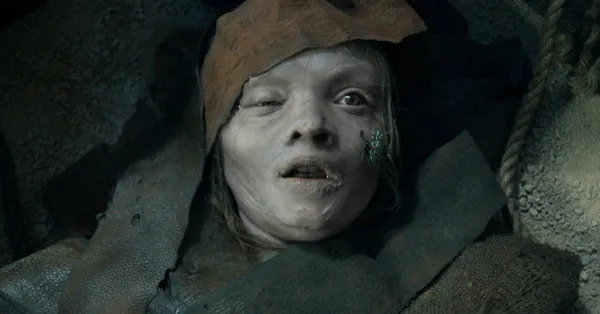
Written and directed by Lee Cronin, Lee Cronin’s The Mummy follows the Canon family on a journalist assignment in Cairo. Charlie (Jack Reynor) is set for a big promotion that will take him, his wife, and two children back to New York. But right as he gets the new job, his youngest daughter, Katie disappears from their garden. Devastated and left without answers, the family moves back to New Mexico to live with his mother-in-law. 8 years later, the family is still reeling from the loss even with a third young daughter who was born shortly after Katie went missing. They receive a call from Egypt that Katie has been found, alive, but she is different, disfigured and in a “locked in” state. She returns home under the care of her parents, but something is definitely not right with Katie. As terrible things keep happening and the mysteries surrounding her disappearance start to come to light, they will soon learn that some secrets should stay buried and something has come back with Katie to terrorize them all. The film also stars Laia Costa, May Calamawy, Veronica Falcon, and Natalie Grace.
Effective Horror Sights But Incoherent Narrative
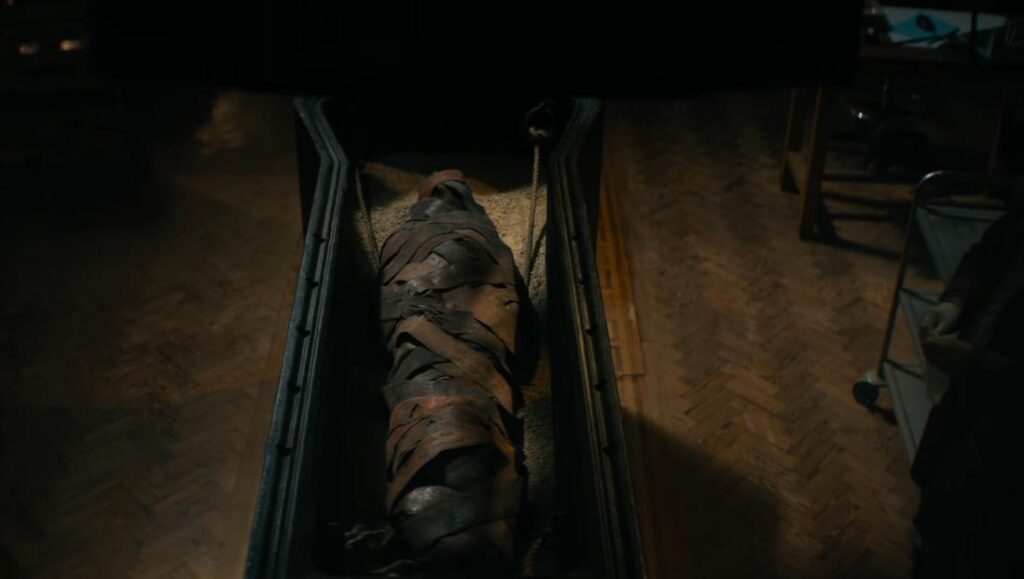
Lee Cronin’s The Mummy shines brightest with its sick and twisted practical effects, incredible lead performance from Grace, and smart visual choices. We love to see practicality, especially in something as in-your-face grotesque as this. Cronin cooks with his camera movement, with more split diopter shots than a Brian De Palma movie. He genuinely knows how to weaponize horror, and Natalie Grace is up for the challenge. She is terrifying and physical, contorting her body and grinding her teeth and really committing to her possession. The rest of the cast is good too – particularly the youngest daughter and young Katie – but they’re largely left in a reactionary state for most of the film with things happening to them rather than them having much agency over any events. Lee Cronin’s The Mummy nails the visuals and brutality, but its connective tissue lacks enough cohesion to really set itself apart.
Far more than just a spiritual sequel, Lee Cronin’s The Mummy truly feels like an abandoned Evil Dead entry. That’s not necessarily a bad thing, but when you leave the follow-up to direct this and then in turn make the movie you left, it does leave you with more questions than answers. Additionally, Cronin can’t really keep track of his own lore, pushing the building blocks of his horror reimagining to the backseat while nothing but the blood takes center stage. That’s fine except it never develops itself into something that feels as urgent or distressing as it should be. For example, the supernatural force that is clearly present in Katie inexplicably switches from an all-powerful entity with unlimited powers to being unable to open a locked door. It’s never really clear just what the monster can and can’t do, removing some of the bite and fear from its scariest moments.
Embrace The Horror Tropes
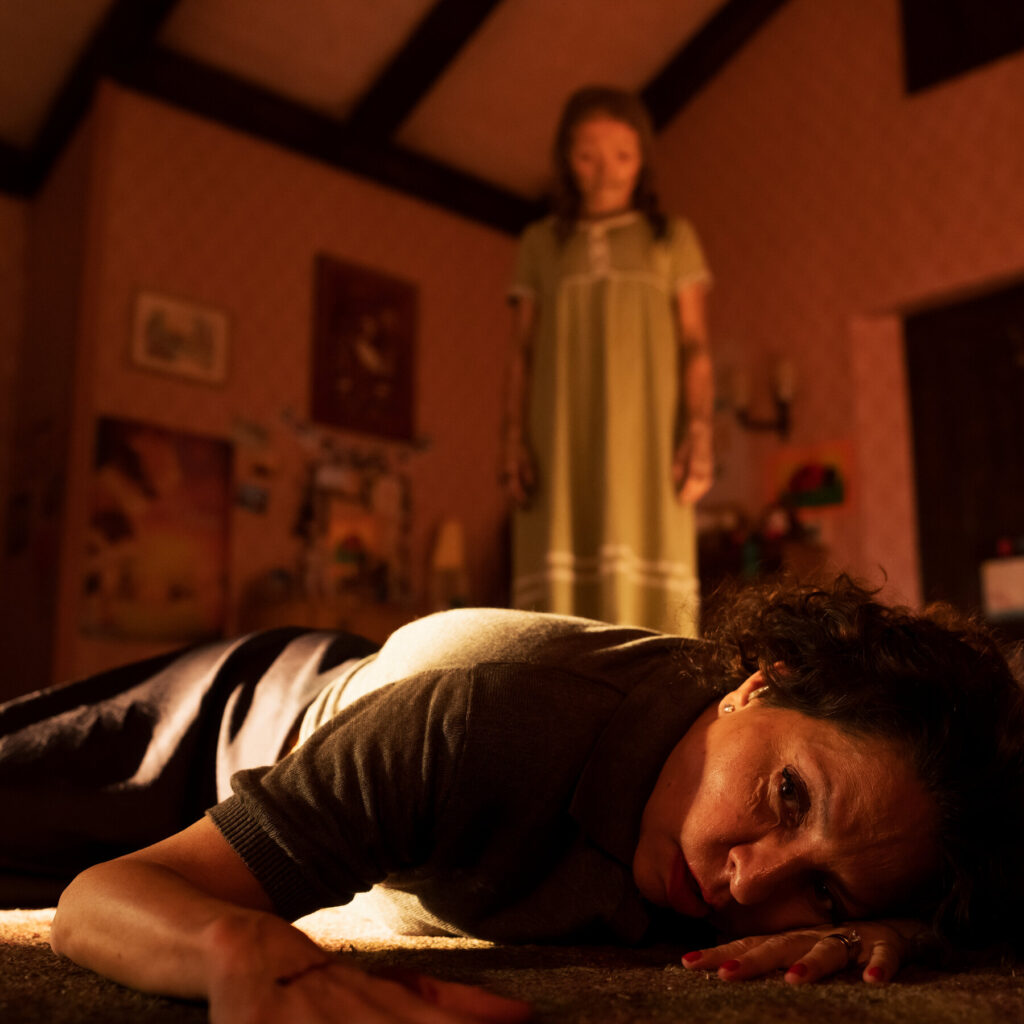
Lee Cronin’s The Mummy with vibrate with terror in one scene, then completely reset in the next. Horrible things happen to someone in the house – par for the course in a haunted house/possession movie – and somehow no one else saw, heard, or even asks about it. It’s not like something being wrong with Katie isn’t obvious even to a grieving family who turns a blind eye in their shock and grief. But no one in the Canon household seems all that bothered or distressed by anything around them and if they care to notice it, they brush it off pretty quickly. I can’t list all of the awful things that befall the family, but the lack of acknowledgement, paired with an unexplained lore bogs this down greatly from the heights it has the potential to reach.
There’s also no reason whatsoever that Lee Cronin’s The Mummy is over 2 hours long. Especially when the things that should fill the padded runtime are things like world building, lore exposition, and deeper character development – all sadly undercooked and noticeably absent. Cronin comes right to edge of embracing cliches then quickly backs off, leading to a bit of frustration and confusion in moments where they shouldn’t be. The film includes the classic professor who studies ancient Egyptian text. Of course Charlie finds him and asks for his help, and what should be another body to brought into the fold to be violently dispatched but also arms our heroes with the ways of stopping evil, our supposed exposition dump gives us very little and then disappears entirely. He never truly enters the story in any meaningful way, and it’s that kind of will they won’t they trope flirtation that really hinders Lee Cronin’s The Mummy throughout the film.
Final Thoughts
For a movie wanting to be a mystery detective story and a creature feature horror movie, skimping on these vital inclusions while including them leaves most of its best moments wanting and brings it all to a screeching halt often. But even with all its drawbacks, it’s got enough visual flare and mean spirited sensibility to satiate lovers of the macabre. Horrors heads will be in for gnarly treat with this one, even if the story isn’t as resonate as one might like. For the most part, Cronin gives the people what they want: fear and unforgettable evildoings with unflinching cruelty and brutality. Lee Cronin’s The Mummy has plenty to enjoy and enough of the things fans love, and while it’s lacking in a number of other placing that make it a frustrating watch at times, it will still leave you with images that keep you up at night.
For more Reviews, make sure to check back to That Hashtag Show.

![‘Rumours’ Writing/Directing Team Talk Blending Politics, Writing Anxiety, and Monsters [Interview]](http://18.211.146.234/wp-content/uploads/2024/10/project_20241023_1158429-01-440x264.png)

 That Hashtag Show
